Project context
The setting
A WooCommerce website built with Elementor required a mobile performance investigation before implementation priorities could be agreed.
Challenge
The problem to solve
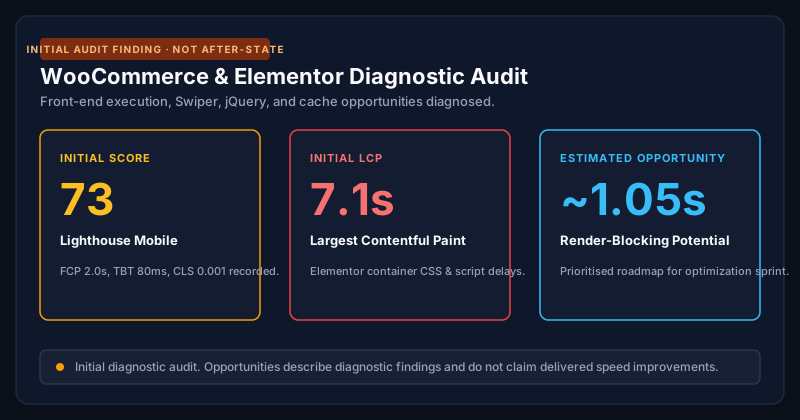
The initial audit recorded a 73 Performance score and 7.1-second LCP, with work spread across CSS, JavaScript, fonts, cache opportunities, and request chains.
My role and scope
What I was responsible for
I carried out the initial technical audit, traced the main front-end bottlenecks, and translated the findings into a targeted optimization roadmap.
Investigation and reasoning
- Reviewed Elementor and WooCommerce CSS, Swiper, jQuery, and JavaScript execution
- Traced forced reflows and critical request chains
- Measured cache, font, and duplicated-script opportunities
Approach and implementation
- Documented the highest-impact bottlenecks
- Prioritised changes by likely impact and implementation risk
- Prepared a focused roadmap for the next optimization phase
Audit Findings
Audit Findings & Diagnostic Baselines
Baseline measurements and diagnostic savings potential identified during the initial investigation (not delivered after-state claims).
This record documents diagnosis rather than a completed speed improvement. The audit identified approximately 1.05 seconds of potential render-blocking savings and other opportunities; these estimates are not after-state results.
- Initial Performance
- 73
- Initial LCP
- 7.1s
- Estimated opportunity
- ~1.05s
Render-blocking estimate
Evidence note
Initial mobile Lighthouse audit: Performance 73, FCP 2.0s, LCP 7.1s, TBT 80ms, CLS 0.001, Speed Index 3.9s. No verified post-implementation report is stored.
Constraints and lessons
What this work made clear
- An audit finding is not the same as a delivered performance gain
- WooCommerce cache changes need to protect cart, account, and checkout behaviour