Project context
The setting
A compromised WordPress ecommerce site had generated a large volume of unwanted URLs that were subsequently indexed by Google.
Challenge
The problem to solve
Cleaning the website did not remove the search-engine footprint. Malicious URL patterns, sitemap manipulation, and index bloat continued to affect crawl and index signals.
My role and scope
What I was responsible for
I investigated the affected WordPress installation and the resulting indexation issue, removed the malicious source, and managed the technical cleanup and monitoring process.
Investigation and reasoning
- Identified the malicious page-generation source and affected files
- Reviewed Google Search Console and unwanted URL patterns
- Investigated sitemap behaviour and the scale of index bloat
Approach and implementation
- Removed the malicious code responsible for generated pages
- Corrected sitemap behaviour
- Applied appropriate 404 and 410 handling to unwanted URLs
- Monitored the indexed URL count as Google revisited the affected URLs
Measured Results
Verified Results & Performance Data
Quantitative before-and-after improvements and documented outcomes recorded during the project scope.
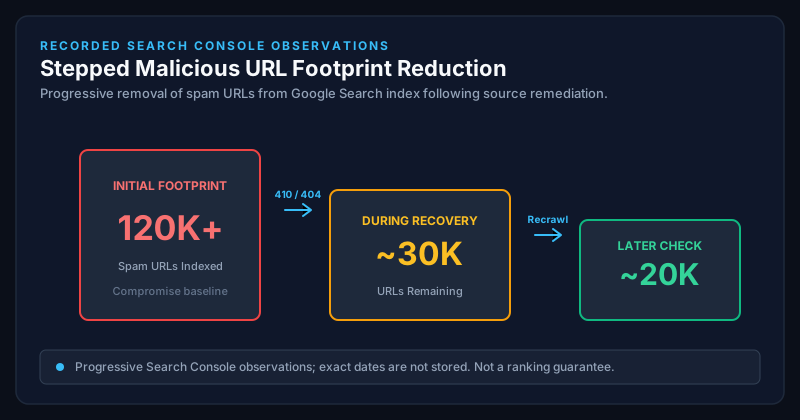
The project record shows the unwanted indexed URL count moving from more than 120,000 to approximately 30,000 during recovery and then approximately 20,000. The figures describe progressive Search Console observations, not a ranking guarantee.
- Initial indexed footprint
- 120K+
- During recovery
- ~30K
- Later observation
- ~20K
Evidence note
Google Search Console counts recorded in the project data. Exact observation dates and a publishable report export are not stored in the portfolio.
Constraints and lessons
What this work made clear
- Malware cleanup and search-index recovery are separate workstreams
- Large unwanted URL sets require correct status handling and patient monitoring